
Menu
 For almost forty years, Villa has worked mainly in steel, interspersed with short periods of modeling for bronze. In this recent series of steel sculptures, he shows his consummate mastery of the medium, creating powerful, evocative works that evoke the human figure at times. The full richness of a formal language that he has built up over many decades, comes into play: seemingly mechanical forms, softer curves derived from modeled shapes, the solidity suggested by solid cast bronzes.
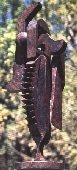
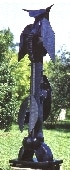
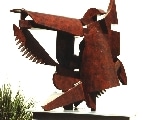
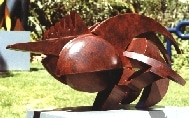
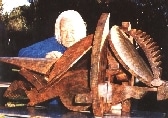
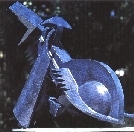
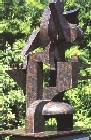
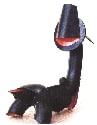
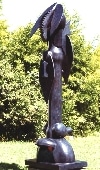
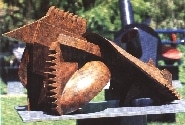
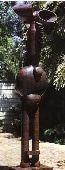
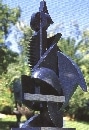
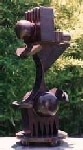
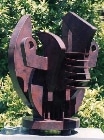
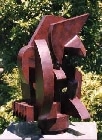
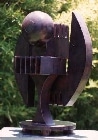
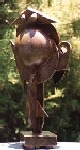
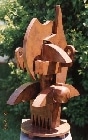
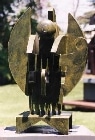
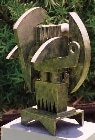
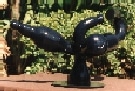
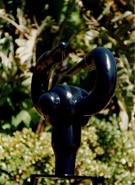
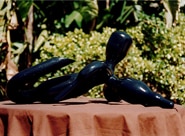
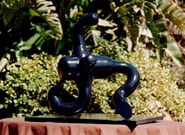
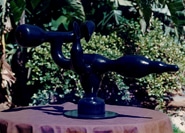
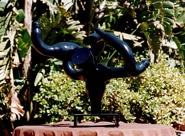
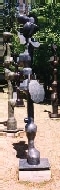
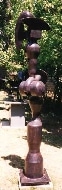
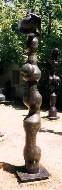
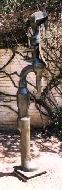
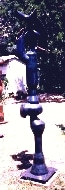
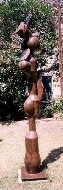
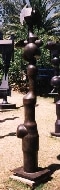
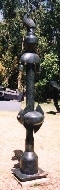
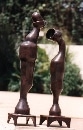
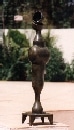
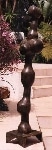
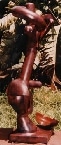
Although his work at first glance appears to be non-representational, Villa is an inherently figurative artist who draws his inspiration from his immediate environment his main source of inspiration has always been man. His work, however, cannot be described as representational, for the symbolism and imagery Villa has invented is personal and independent of visual reality. Humor, the sensual, aggression and the serious are various emotions experienced when viewing Villa's sculptures. His work exudes a powerful inner energy.
Over the past fifty seven years Villa has created an unsurpassed body of work, in number, quality, and scale. His works have become an integral part of the quality of space in and around buildings in every South African city.
1935-1957: Years of early development, from classical, stylized, carved works tending towards voluminous shapes while still in Italy, to more expressionistic works in the early forties. Expansive, rounded forms followed in creating woman as archetype during the late forties. Then Villa broke away to abstraction in minimal torsos and plant-like figures. 1955 was a turning point with the discovery of the use of metal, and a dramatic change with line and plane becoming major formal elements expressing internal dynamic forces. Villa had found construction in steel the method most suited to him.
1957-1970: Exploring construction by welding and attaining exuberance in bronze. Villa works without sketches, directly in the material. Strips of metal give rise to space enclosing compositions. The vertical framework, not always figurative, becomes very important. Works start to express situations and relationships. References to Africa increase. During the early sixties the structures become more figurative, symmetrical, and frontality is prevalent, emphasizing a hieratic quality. Color appears as a binding element in the figurative works. Precise finish is a permanent characteristic. Villa regularly returns to modelling resulting in reciprocal formal enrichening. The bolder, fuller forms in clay are transposed to voluminous steel shapes. Found elements of machines were assimilated to create humanized technology.
During the late sixties head studies, rather than portraits, occur. Forms are reduced to the column, sphere and tube. The previously enclosed composition is exploded to create many seated and horizontal figures in both bronze and steel, called his playful giants. Size increases, as does the emotive value of physical presence. With the reduction of symmetry, and increased gesture, large masses become very dynamic. Universal themes of man in all guises predominate.
1971-1979: Further development of scale and multiple composition. Form is drastically reduced to spindles and sheets; mass is dernaterialized, also by shiny surfaces; line and plane dominate; mostly group compositions of parallel elements with only very subtle reference to the human figure occur. Gesture is controlled. The cut appears, creating subtle tension by suggesting instability.
In the mid-seventies the pipe or column becomes the prime formal element in mainly vertical compositions symbolizing group relationships and the tensions within them. Color now features strongly both as dernaterializing and binding medium. In the late seventies Villa developed large groups, encompassing both geometric and organic formal elements in his use of overlapping, cut open rounded pipes and rectangular channels. The metal was allowed to rust, resulting in a rich velvety patina, which was to influence his future use of color. The vertical encapsulated composition was less evident, with open structures becoming impersonal images of modern mechanical warfare, as can be seen in "Confrontation" on the front page.
1980-1989: Evolution of a symphony of metal forms, both geometric and organic. The large retrospective exhibition in 1980 was followed by a great variety of abstract works before he returns to the figure, the main theme of his oeuvre. The first combination of bronze organic shapes enclosed in steel geometric containers, and the series of large asymmetrical "Prisoners" followed. The sheets and bars open up to become steel structures, subtle symbols of both the machine of war and the victim.
In the late eighties huge pipes and other rounded steel forms become animalistic/ humanoid images, in which sparingly applied strong color appears to accentuate the interior/exterior dichotomy. In these assertive works, Villa's vitality and the freedom of form in space in his sculpture is affirmed.
1990-1993: Villa briefly ventures into a new medium - the found shapes of polystyrene packaging. These brightly painted compositions give rise to compact, textured bronzes, small icons of the fortified, the aggressor, the fortress. These stimulate the incorporation of heavy, toothed forms into new steel sculptures: vertical anthropomorphic or horizontal non-figurative compositions in which the lively dialog between geometric form and organic structure and rhythm continues, giving rise to ever more and richer interpretations of man and his condition.
 The University bestowed on him the Chancellor's Medal of the University of Pretoria and later a honorary professorship in recognition of his stature as artist.
He confirmed his benevolent association with the University firstly by donating several large steel sculptures which are exhibited on the campus and later by his decision to donate an important part of his creative work to the University. These pieces, 143 in total, have been incorporated into the Edoardo Villa Trust and are on permanent display in the Edoardo Villa Museum. This museum was specially designed and furnished by Uwe Günther for this purpose, through the mediation of, in particular, Dr Viktor Hesse and two previous Principals, Profs. Danie Joubert and Flip Smit.
The Edoardo Villa Museum is an important addition to the University's art posessions. Together with the Van Wouw collection it places the University in the enviable position of owning collections of two of South Africa's foremost sculptors.
These collections and the other extensive art collections owned by the University of Pretoria are important resources for research not only by students of the University but also for artists and art historians in general.
The museum was opened on 31 May 1995, on Edoardo Villa's 80th birthday. It is situated on the main campus of the University of Pretoria in the Old Merensky Library. The foundation stone for this historical building was laid in 1937 by General Jan Smuts, then Prime Minister. In 1939 the building, designed by the renowned South African architect Gerard Moerdyk, was inaugurated and in 1991 declared a National Monument, thereby restricting the design possibilities for its conversion into the present museum, which was done by Fritz-Uwe Günther. After being used for its intended purpose until the new library was completed, the building housed the Department of Fine Arts and later served as a 24-hour study centre.
As many students link memories to this particular place on the University's campus, it seems especially appropriate that the magnificent volume now also houses the spirit of Edoardo Villa's sculpture. 'These strong, solid and silent works stand in a soaring interior of gleaming wood, marble, and granite. The museum's muted colours of beige, grey and white are a remarkable foil for the sculptures with their tones of dull bronze, their patinas of rust, green and iron black. [ ... ] They suggest self-possession, equilibrium, rest and poise. They fill the museum with an atmosphere almost ancient in its silence and stillness.' (Muffin Stevens, Lantern, Spring 1995.)
The University bestowed on him the Chancellor's Medal of the University of Pretoria and later a honorary professorship in recognition of his stature as artist.
He confirmed his benevolent association with the University firstly by donating several large steel sculptures which are exhibited on the campus and later by his decision to donate an important part of his creative work to the University. These pieces, 143 in total, have been incorporated into the Edoardo Villa Trust and are on permanent display in the Edoardo Villa Museum. This museum was specially designed and furnished by Uwe Günther for this purpose, through the mediation of, in particular, Dr Viktor Hesse and two previous Principals, Profs. Danie Joubert and Flip Smit.
The Edoardo Villa Museum is an important addition to the University's art posessions. Together with the Van Wouw collection it places the University in the enviable position of owning collections of two of South Africa's foremost sculptors.
These collections and the other extensive art collections owned by the University of Pretoria are important resources for research not only by students of the University but also for artists and art historians in general.
The museum was opened on 31 May 1995, on Edoardo Villa's 80th birthday. It is situated on the main campus of the University of Pretoria in the Old Merensky Library. The foundation stone for this historical building was laid in 1937 by General Jan Smuts, then Prime Minister. In 1939 the building, designed by the renowned South African architect Gerard Moerdyk, was inaugurated and in 1991 declared a National Monument, thereby restricting the design possibilities for its conversion into the present museum, which was done by Fritz-Uwe Günther. After being used for its intended purpose until the new library was completed, the building housed the Department of Fine Arts and later served as a 24-hour study centre.
As many students link memories to this particular place on the University's campus, it seems especially appropriate that the magnificent volume now also houses the spirit of Edoardo Villa's sculpture. 'These strong, solid and silent works stand in a soaring interior of gleaming wood, marble, and granite. The museum's muted colours of beige, grey and white are a remarkable foil for the sculptures with their tones of dull bronze, their patinas of rust, green and iron black. [ ... ] They suggest self-possession, equilibrium, rest and poise. They fill the museum with an atmosphere almost ancient in its silence and stillness.' (Muffin Stevens, Lantern, Spring 1995.)